- October 11,2026
- 4 days ago
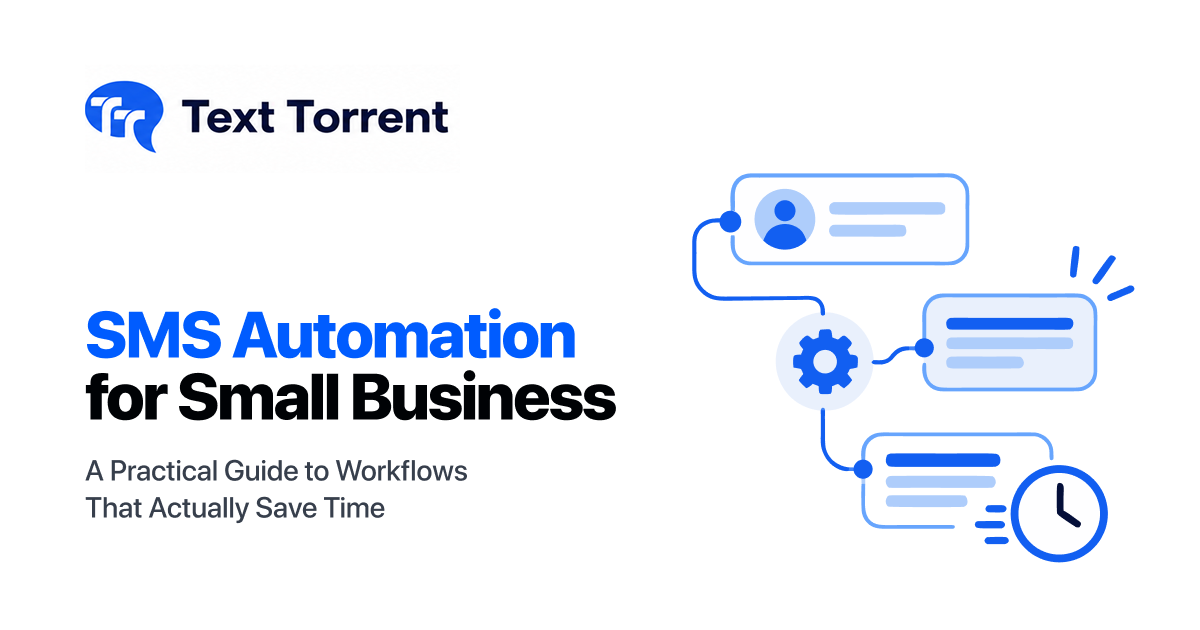
SMS automation for small businesses is useful when it removes repetitive work without removing judgment. The goal is not to automate every customer interaction. It is to make predictable steps happen reliably, then move the conversation to a person when questions, exceptions, or judgment appear.
Small teams usually do not fail because they lack messages. They fail because a lead waits too long for acknowledgement, an appointment reminder is forgotten, a customer receives the wrong follow-up, or nobody notices a reply.
TextTorrent’s trigger-based messaging workflows can connect supported triggers to actions such as sending a text, waiting, updating a tag, creating a task, applying a condition, notifying a team member, or ending a workflow. Its two-way customer conversation tools give teams a place to continue conversations when automation should give way to human follow-up, while organized contact management keeps audience and status data connected to the messaging process.
For appointment-heavy businesses, that can mean automating routine confirmations while preserving human control. Restaurant communication workflows can support reservation reminders, while real estate messaging workflows can support showing and appointment follow-up.
The right starting question is not “What can we automate?” It is:
Which repeated communication currently depends on someone remembering to do it?
SMS automation is a rule-based process that sends or manages messages after a defined event.
A useful model is:
Trigger → Eligibility check → Message → Wait → Condition → Handoff or next action → End
The trigger might be a new contact, status change, assigned tag, opportunity update, or another supported business event. TextTorrent’s current automation builder supports trigger concepts such as contact creation or updates, opportunity activity, stage changes, imports, and assigned tags.
Good automation starts from something the system can identify reliably.
“Send a useful message when the customer might need one” is not a workflow.
“Send the appropriate follow-up when a qualified business event occurs” is.
Automation is also different from scheduling. Scheduling sends a prepared campaign at a known date and time. Automation reacts to an event or state change. Use scheduling for a Friday promotion. Use automation when individual customers reach the same process step at different times. TextTorrent also offers SMS scheduling for campaigns that need to go out at a predetermined time.
The best first workflow is usually not the most sophisticated one. It is the repetitive process that creates a visible operational problem when staff miss it.
A new inquiry should not sit unnoticed because the owner is on a call or away from the desk.
A simple automation can acknowledge the inquiry and collect one useful detail:
Hi Jordan, this is Riverstone Roofing. We received your estimate request. What ZIP code is the property in?
The automation should not pretend someone reviewed the request or promise availability that has not been checked.
A practical flow is:
New lead → Check eligibility → Send acknowledgment → Create follow-up task → Team handles reply
Automation covers the predictable part. The team owns the judgment.
Appointment communication works well with structured workflows because the event and desired action are usually explicit.
A restaurant might send a reservation reminder. Real estate messaging workflows might support a showing confirmation. A service business might remind a customer about an estimate window.
What breaks when the workflow is poorly designed?
A canceled appointment still receives a reminder, or a rescheduled customer receives information based on the old booking.
The fix is to check current customer state before sending. Do not let the workflow depend only on information captured when the appointment was first created.
3. Welcome Messages
A welcome automation should confirm what just happened and establish expectations.
Thanks for joining Oak & Pine updates. We’ll text you about new arrivals and occasional offers. Reply STOP to opt out.
Do not turn a welcome workflow into five immediate promotional messages unless that frequency was clearly expected when the person enrolled.
For many small businesses, one confirmation plus one useful next step is enough.
4. Status and Process Updates
Automation is valuable when customers repeatedly ask, “What happens next?”
Useful events include:
order received
appointment confirmed
application stage changed
documents still needed
item ready for pickup
delivery status updated
service request assigned
For example, e-commerce messaging workflows can use texts around order, delivery, cart, or customer lifecycle activity where the workflow and consent support it.
The decision rule is simple:
Automate facts the system actually knows.
Do not automate approvals, estimates, guarantees, or outcomes that still depend on human review.
This workflow is easy to overuse.
No reply does not automatically mean the customer needs another text. They may be busy, the first message may not require a response, or the timing may have been poor.
A useful follow-up adds context:
Hi Sam, following up on your request for Tuesday. If you still need an appointment, reply with a good time and we’ll check availability.
A weak follow-up simply repeats the original message.
Set a limit. Repeating essentially the same message several times creates additional volume without adding information.
A workflow should be a decision process, not merely a chain of messages.
What exact event starts it?
Examples include contact created, tag assigned, opportunity stage changed, or another supported activity.
ShouldShould this contact receive this particular message?
Check consent, suppression status, customer state, previous action, and any other condition that would make the message irrelevant or inappropriate.
What should happen now?
TextTorrent supports automation actions including sending SMS, adding or removing tags, creating tasks, updating supported fields, notifications, delays, conditions where supported, and clear workflow endings.
Why are you waiting?
“Wait three days because that is how the template was built” is weak logic.
“Wait until the next appropriate point in this customer process” has an operational reason.
Condition
What changed during the wait?
Did the customer reply? Did they complete the requested action? Did the opportunity change stage? Are they still eligible?
Conditions prevent every contact from being pushed through the same path after their circumstances have changed.
Questions, objections, rescheduling, sensitive subjects, unusual situations, and high-value opportunities frequently require a person instead of another automated step.
Define what completion means.
A customer should not remain inside an automation indefinitely because nobody decided when the sequence should stop.
Automated SMS creates replies. That means the inbox is part of the automation architecture.
Suppose a customer replies:
Can we do 3 PM instead?
If the system continues sending messages based on the previous arrangement, the automation is technically functioning but operationally broken.
TextTorrent’s two-way messaging supports reply handling through its Claims or inbox workflow, allowing team members to review conversation history and continue the interaction with clearer ownership. TextTorrent does not claim that every reply automatically stops or modifies every automation, so stop conditions and handoff behavior should be verified while building the workflow.
A useful operating rule is:
Automation handles predictable steps. People handle interpretation.
Organize Contact Data Before You Automate
Automation amplifies whatever data you give it.
If tags are inconsistent, customer stages are stale, phone numbers are duplicated, or contacts are assigned to the wrong list, automation can distribute the wrong message faster than a person could.
Before activation, define:
which event starts the workflow
who must be excluded
which tags or stages can change
what counts as completion
which information must stay current
who owns exceptions
TextTorrent’s contact workspace for subscriber groups and messaging records supports contact lists, folders or tags, messaging status, campaign audience selection, and related conversation context where available.
Keep the model simple.
Three reliable lifecycle states are more useful than twenty tags nobody trusts.
Automation increases the importance of consent and suppression controls because one mistake can repeat without anyone noticing.
For U.S. application-to-person business messaging over local 10-digit numbers, appropriate A2P 10DLC registration is part of the messaging setup. Registration does not convert an arbitrary phone database into an appropriate messaging audience. The messaging still needs to align with the registered use case, recipient status, applicable requirements, and suppression controls. TextTorrent provides A2P 10DLC registration support for eligible business messaging programs.
Before enabling automation, verify:
how the contact entered the messaging program
whether the automated message matches that context
whether opted-out and blacklisted contacts remain excluded
whether the registered use case matches the workflow
how manual opt-out requests are handled
Suppression should be deterministic.
Do not make an AI model or free-text interpretation responsible for deciding whether an opted-out contact can be messaged again.
Small businesses frequently rewrite the same acknowledgment, reminder, status update, and customer-service message.
Reusable templates reduce that inconsistency.
TextTorrent’s reusable message library supports saved templates, active or inactive status, supported personalization variables, and reuse in applicable messaging workflows.
But templates age.
A booking link changes. An employee leaves. An offer expires. Business hours change. Old wording becomes inaccurate.
Review automated copy periodically and test the final rendered message with realistic contact data before a live send.
Also check message length. Personalization, links, emojis, Unicode characters, and opt-out wording can change how the final text is segmented. A message that looks short in the editor may become multiple SMS segments after variables are populated.
Measure Whether the Automation Solved the Original Problem
Do not measure success by the number of automated texts sent.
If the workflow exists to reduce appointment problems, measure confirmations and the operational outcome.
If it exists for lead follow-up, measure response time, replies, handoffs, and qualified next steps.
Useful operational metrics include:
workflow entries
delivery failures
reply rate
human handoffs
completed customer actions
opt-outs
contacts stuck in a workflow
duplicate or conflicting messages
TextTorrent’s campaign reporting tools can show campaign activity, delivery-related statuses, replies, and message-level information where those results are available. Importantly, a delivery confirmation is not proof that someone read or acted on a message.
Use reporting to diagnose the workflow instead of assuming “sent” means successful.
Common SMS Automation Mistakes
A ten-step workflow creates ten places to fail.
Do it right: Start with one trigger, one useful message, one handoff rule, and one defined end state.
“Wait two days, then text again” ignores whether the customer already completed the action.
Do it right: Recheck customer state before every follow-up.
Automated messages can collide with an active sales or support conversation.
Do it right: Define an ownership or workflow state that prevents irrelevant automated follow-up.
A prospect, active customer, lapsed customer, and opted-out contact should not follow one sequence.
Do it right: Apply lifecycle and eligibility logic before message timing.
An automation can keep running after its copy, links, timing, or underlying business process becomes outdated.
Do it right: Review active workflows on a fixed schedule and after meaningful operational changes.
Before switching on a workflow, confirm that:
the trigger represents a real business event
eligibility is checked before sending
the message has one clear purpose
delays have an operational reason
the workflow checks whether the customer already acted
incoming replies have an owner
the workflow can end cleanly
suppressed contacts remain excluded
templates and links have been tested
performance is measured against the original problem
SMS automation for small businesses works best when it removes predictable gaps from everyday operations.
Start with the message someone currently has to remember: a new-lead acknowledgment, appointment reminder, document follow-up, order update, or next-step notification.
Define the trigger. Check eligibility. Send one useful message. Decide what happens if the customer replies. Define the end.
TextTorrent connects automation with contact organization, reusable messages, scheduled and bulk business messaging workflows, two-way conversations, and reporting.
The value is not that every message can be automated. It is that routine steps can happen consistently while your team keeps control of the conversations that require judgment.
A good automation should make the business feel more organized to the customer—not more automated.