- October 11,2026
- 4 days ago
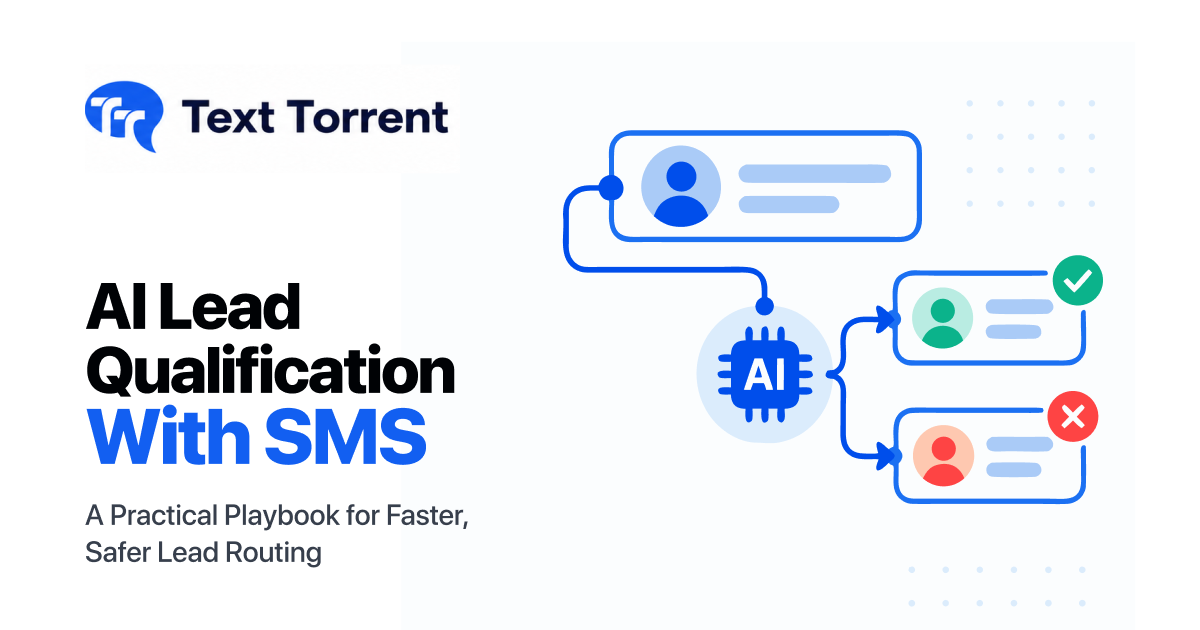
AI lead qualification with SMS sounds simple: a lead texts back, AI reads the reply, assigns a score, and sends the best prospects to sales.
In production, the hard part is deciding what the reply means, what information is missing, whether another automated message is appropriate, and when a human should take over. Weak decisions create bad routing, duplicate follow-up, awkward conversations, and compliance risk at higher speed.
A reliable system treats SMS as a qualification channel, not just a broadcast channel. Businesses using two-way text messaging can maintain ongoing conversations with prospects while keeping replies connected to their original context.
TextTorrent can support that operating model through bulk campaigns, automation, contact organization, campaign analytics, API connections, and A2P 10DLC registration support. The important design choice is to keep qualification state connected to the conversation instead of treating each reply as an isolated message.
This guide explains how to build that system and what usually breaks.
AI lead qualification with SMS is the process of using a model to interpret lead replies, extract useful sales information, update qualification status, and determine the next action in a text-message workflow.
A good system can identify signals such as need, location, budget, urgency, decision authority, objections, next-step requests, or opt-out intent.
The output should not simply be “hot,” “warm,” or “cold.” It should produce structured fields another workflow can use.
For example:
Intent: interested
Timeline: within 30 days
Budget: unknown
Location: eligible
Human review: not yet required
That structure matters because the next SMS should depend on what is missing, not on a generic sequence. A well-designed SMS automation workflow can support structured follow-up actions without requiring every conversation to follow the same predetermined path.
Qualification works best when the prospect can answer with little effort. SMS keeps questions short and conversational without forcing a lead through another form or phone call.
But SMS is ambiguous.
A reply like “maybe next month” might indicate timing, low intent, a soft objection, or a request to follow up later. “Yes” is meaningless unless the system knows which question the lead is answering. “Send info” is not the same as “ready to buy.”
Many AI qualification systems fail because they classify the latest message without enough conversation context.
The fix: qualify from the thread, not from one message.
Do not begin by asking, “What should the AI say?”
Start by deciding what sales actually needs to know.
A qualification schema should contain only fields that change routing or next steps. If a field does not affect what happens next, do not force the lead to answer it.
For a service business, that might include:
need or requested service
geographic eligibility
timing
estimated budget
decision authority
preferred next step
The schema should change by industry. Property lead follow-up may need target area, price range, and timeline. Mortgage workflows may care more about loan purpose, amount, and application stage. Insurance quote teams may need product type, state, and renewal date.
For example, an MCA SMS marketing workflow may prioritize funding requirements, business eligibility, and urgency before directing a merchant to a funding representative.
Qualification is a business decision, not a language-model decision.
Once the required fields are defined, they should remain attached to the lead record. An organized contact management system helps teams maintain contact context, audience organization, and relevant information as conversations progress.
The fastest way to make automated qualification feel robotic is to send four or five questions at once.
Ask one high-value question, evaluate the reply, then ask the next question only if it is still needed.
A practical flow looks like this:
Confirm the lead's request.
Ask the highest-value routing question.
Classify the answer and update the contact.
Ask one missing qualification question.
Escalate when the lead is qualified, confused, sensitive, or asks for a person.
Stop when the lead opts out, becomes ineligible, or no longer wants contact.
Example:
“Hi Maya, thanks for reaching out about business funding. Are you looking for capital this month, later this quarter, or just comparing options?”
If the reply is “this month,” the next message should not ask about timing again. It should collect the next missing field.
Repeat questions are one of the clearest signs that an automation is not maintaining state.
Separate Classification From Messaging
Do not let one AI prompt decide everything.
A safer architecture separates three jobs.
The model extracts intent and fields from the conversation.
Deterministic logic decides whether the lead is eligible, whether another automated question is appropriate, and whether a salesperson should be assigned.
Only after the route is known should the system choose the response.
This separation matters because language models are probabilistic. Your eligibility rule should not change because a model found a creative interpretation of “maybe.”
TextTorrent automation and two-way conversation tools can handle messaging and follow-up while qualification logic remains explicit in the connected lead process.
For businesses building custom qualification systems, an SMS API integration can connect messaging operations with CRM records, application logic, and qualification data. The external system can then determine the next action using the latest available lead information.
Use Confidence Thresholds, Not Forced Answers
Every classifier should be allowed to say, “I am not sure.”
A useful decision rule is:
High confidence: update the field and continue.
Medium confidence: ask a short clarification question.
Low confidence: do not guess; route to a person or leave the field unknown.
Sensitive or exceptional request: hand off immediately.
Suppose the system asks, “Are you looking to move within 90 days?”
The lead replies, “Depends if my house sells.”
A weak system may mark that as “No.” A better system records the timing as conditional and asks for clarification.
Unknown is a valid state. Incorrect certainty is worse than missing data.
AI should qualify repetitive, bounded questions. It should not be expected to negotiate, interpret complex exceptions, or keep talking after the lead clearly wants a person.
Escalate when:
the lead asks for a call or representative
the lead raises a pricing, legal, contractual, or sensitive question
confidence remains low after one clarification
the lead gives contradictory information
the lead appears highly qualified and speed matters
the reply does not fit the supported workflow
With TextTorrent's shared SMS inbox, replies can stay connected to the conversation so a team member can review previous messages and take ownership rather than starting from zero.
The qualification process should also recognize when a human has already taken over. Continuing automated questions during an active sales conversation can frustrate prospects and create conflicting information.
A common mistake is collapsing every signal into one number.
A lead can have strong intent but poor fit. Another can be an excellent fit but have a six-month timeline.
Use at least two dimensions:
Fit: Can you actually serve this lead?
Intent: How close is the lead to taking the next meaningful step?
High fit + high intent should usually create immediate human follow-up. High fit + low intent may enter nurture. Low fit + high intent should not be pushed to sales if the business cannot serve the lead. Unknown fit should trigger qualification, not aggressive follow-up.
This makes reporting more useful because “not converted” no longer hides bad fit, low urgency, missing information, or missed follow-up.
“Thanks” or “sounds good” can be acknowledgment, not qualification.
Fix: Require specific evidence for each status change.
The lead gets a qualification question while a salesperson is already speaking with them.
Fix: Create a human-owned state that blocks automated qualification messages.
No reply can mean poor timing, filtering, an unread message, or distraction.
Fix: Treat non-response as unknown unless another verified signal exists.
If the lead never gave a budget, the system should not infer one from job title, ZIP code, or writing style.
Fix: Allow null values and collect only what is operationally necessary.
Timing, needs, and ownership change.
Fix: Timestamp important fields and define when they must be reconfirmed.
Do not ask AI to decide whether a contact is eligible to receive a marketing text.
Consent, suppression, opt-outs, campaign registration, sending identity, and messaging purpose should be enforced by deterministic controls and documented procedures.
For U.S. local-number business messaging, A2P 10DLC registration helps identify the sender and messaging use case, but registration does not create recipient consent. Opt-out requests still need to be honored, and campaign behavior should match the consent and use case under which the messaging program operates.
An AI model may interpret a reply, but it should never override suppression, reactivate an opted-out contact, or assume a purchased lead is safe to text.
Before activation, verify:
how the number and consent were collected
what message types the person agreed to receive
whether the contact is suppressed or blacklisted
whether the registered use case matches the campaign
whether opt-out handling works correctly
TextTorrent's registration support and SMS opt-out and blacklist management belong around the qualification system, not inside the model's judgment.
These controls are especially important when automated campaigns process large contact lists or multiple follow-up sequences. A qualification model should never be able to bypass an established opt-out restriction simply because it predicts a strong chance of conversion.
A reliable implementation has seven stages.
Start only from a defined event: a new opted-in lead, inbound inquiry, form submission, campaign reply, or approved stage change.
Confirm the request without pretending the lead is already qualified.
Send the single question with the highest routing value.
Extract the answer into structured fields, attach confidence, and preserve the original reply.
Apply eligibility, fit, intent, consent, and handoff rules.
Stage 6: Continue or Hand Off
Ask another question when necessary, move qualified leads to a representative, or place lower-intent leads into an appropriate follow-up path.
When building follow-up audiences from previous campaigns, SMS retargeting can help teams distinguish contacts who replied from those who did not. However, these audiences still need current consent and suppression checks before further outreach.
Use campaign analytics and conversation outcomes to find where leads stop replying, where classifications are corrected, and which questions actually predict the next sales step.
Measure the System Like an Operations Funnel
Do not judge the workflow only by reply rate.
Track:
qualification completion rate
average messages required to qualify
human-handoff rate
percentage of AI classifications corrected by staff
qualified-to-meeting or qualified-to-next-step rate
opt-out rate by question
duplicate or erroneous follow-up incidents
leads stuck in an unknown state
time from qualifying reply to human follow-up
TextTorrent's SMS campaign analytics can help teams review delivery statuses, campaign activity, and replies before deciding what should happen next.
Qualification-specific measurements, such as AI classification accuracy and qualified-to-meeting conversion, may require additional tracking through a connected CRM or reporting system.
The goal is not to keep messaging everyone. It is to understand what happened before deciding who should receive another message.
Final Checklist Before You Launch
Before turning on AI lead qualification with SMS, confirm that:
every qualification field affects a real routing or sales decision
the workflow asks one useful question at a time
the system distinguishes unknown from negative
every classification has a confidence or fallback path
automation stops when a human takes ownership
opt-outs and suppression are enforced outside the model
staff can see the original conversation, not just a summary
classification corrections are measurable
stale fields expire or get reconfirmed
messaging use matches consent and registration
If not, fix the workflow before adding more AI.
The Better Way to Think About AI Lead Qualification With SMS
The goal is not to make an AI agent sound human for as long as possible.
The goal is to reduce the distance between a legitimate lead inquiry and the correct next action.
That requires short questions, explicit qualification fields, deterministic routing, compliance controls, conversation history, measurable handoff rules, and humans where judgment matters. TextTorrent can provide the messaging layer through campaigns, automation, two-way conversations, contact workflows, analytics, and integrations.
When those pieces are designed correctly, AI becomes useful for what it is good at: reading messy replies and turning them into structured signals. The business still decides what those signals mean.