- August 21,2026
- 2 months ago
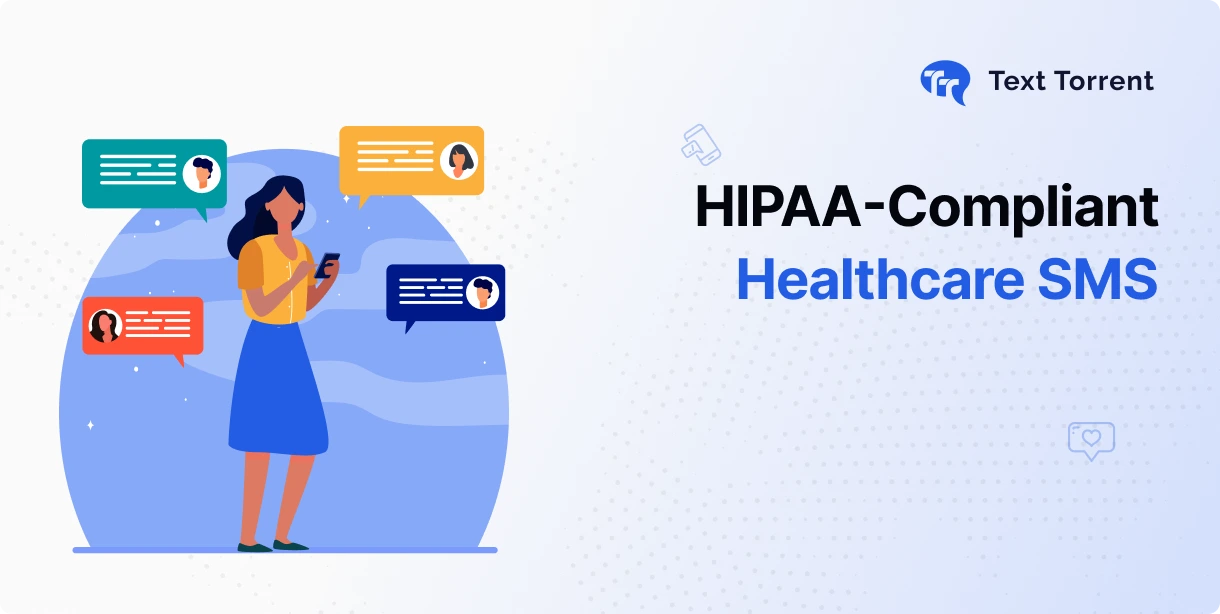
SMS is becoming a default communication channel in healthcare. Appointment reminders, follow-ups, billing alerts, care coordination—patients expect it.But healthcare messaging isn’t just about speed or open rates. It’s about compliance, data exposure risk, and system control. Most providers don’t fail because they send messages. They fail because they underestimate how easily Protected Health Information (PHI) can leak through SMS workflows.
This guide focuses on how HIPAA-compliant SMS actually works in practice—and where systems typically break.
Healthcare teams often start with generic messaging tools and adapt them later for compliance. That approach creates risk at the infrastructure level.
Where the risk comes from
SMS is not encrypted end-to-end
Messages pass through carrier networks in plain text.
Devices are uncontrolled endpoints
Patients’ phones may be shared, lost, or unsecured.
Message logs persist across systems
Carriers, providers, and platforms may retain message metadata.
What breaks if ignored
PHI exposure through message content
Compliance violations during audits
Inability to prove consent or opt-out handling
Legal risk tied to message logs and storage
The issue is not sending SMS—it’s sending the wrong data through SMS.
There’s a common misconception: using a “HIPAA-compliant SMS platform” makes all messages compliant.
It doesn’t.
HIPAA compliance in messaging is a combination of:
1. Controlled content
Messages must avoid transmitting PHI unless properly secured.
Allowed examples:
Appointment reminders without condition details
Generic follow-up message
Risky examples:
Diagnoses, treatment details, lab results
Insurance or billing specifics tied to identity
2. Secure infrastructure
The platform must:
Sign a Business Associate Agreement (BAA)
Control access to message logs
Encrypt data at rest and in transit (within the platform)
3. Consent and auditability
You must be able to prove:
Patient opt-in (when, how, source)
Opt-out handling (immediate and enforced)
Message history tied to consent status
If you can’t produce this during an audit, your system is not compliant—regardless of the platform you use.
These are not edge cases. They are recurring operational failures.
1. Including PHI in “routine” messages
Example:
“Your diabetes test results are ready”
Why it fails:
Condition is identifiable
Message is stored and transmitted without encryption
Fix:
Use neutral phrasing:
“Your test results are ready. Please log in to view.”
2. Treating opt-out as optional
Many systems delay or mishandle opt-outs.
What happens:
Patient replies STOP
System logs it but continues sending from another workflow
Result:
Immediate compliance violation
Increased complaint rates
Carrier-level filtering risk
Fix:
Centralized suppression logic across all campaigns and automations.
3. Using shared messaging infrastructure
Some providers rely on platforms where routing is opaque.
What breaks:
Messages pass through multiple intermediaries
Data exposure risk increases
No control over logging or retention
4. No separation between notification and data access
Teams try to deliver full information via SMS instead of using it as a trigger.
What breaks:
PHI exposure
No secure audit trail for data access
Correct model:
SMS → Notification
Portal → Data access
A compliant system is not just about the platform. It’s about how messaging is designed.
This structured approach is also essential in policyholder communication workflows, where timing and message clarity directly affect service outcomes.
Step 1: Define message boundaries
Decision rule:
If the message can identify a patient’s condition, treatment, or financial data → do not send it via SMS.
Step 2: Use SMS as a trigger, not a container
Structure communication like this:
SMS: “You have a new update. Log in to view.”
Secure portal: Full information behind authentication
This reduces exposure while maintaining speed.
Step 3: Implement strict consent tracking
Checklist:
Capture opt-in source (form, in-person, digital)
Timestamp every consent event
Store consent linked to phone number
Enforce opt-out instantly across all systems
Step 4: Control access internally
Operational controls:
Role-based access to messaging tools
Audit logs for message creation and sending
Restricted visibility of message history
This is where many internal compliance failures happen—not at the carrier level.
Step 5: Monitor for behavioral risk signals
Even compliant content can trigger issues if behavior is off.
Watch for:
Sudden spikes in message volume
High opt-out rates
Low engagement (indicates poor targeting or consent issues)
These are early warnings of both compliance and deliverability problems.
These behavioral signals are also used in insurance messaging workflows, where opt-outs and engagement patterns impact long-term deliverability.
Infrastructure Considerations for Healthcare Messaging
Not all SMS platforms are built for regulated use cases.
What matters in practice:
Direct vs multi-hop routing
Direct carrier connections → more control, fewer exposure points
Multi-hop routing → increased risk, less visibility
Message storage and retention
Ask:
Where are messages stored?
How long are they retained?
Who can access them?
If this isn’t clear, it’s a compliance gap.
Integration with healthcare systems
Messaging should integrate with:
EHR systems (without exposing PHI in SMS)
Scheduling tools
Patient portals
The goal is coordination—not duplication of sensitive data.
Similar infrastructure constraints appear in high-volume SMS campaigns, where routing visibility and pacing determine message performance.
Early-stage setups often “work fine” with low volume.
At scale, issues surface quickly:
Increased patient complaints
Carrier scrutiny due to opt-out patterns
Audit failures due to missing consent logs
Internal confusion over message ownership
Fixing this later is expensive and disruptive.
It’s significantly easier to design compliance into the system from the start.
SMS is one of the most effective communication tools in healthcare—but it’s also one of the easiest places to introduce compliance risk.
The providers that use it successfully in 2025 follow a simple principle:
They don’t try to make SMS secure.
They design systems where SMS never carries sensitive data in the first place.
Everything else—consent tracking, infrastructure, auditability—builds on top of that decision.